Action RPG "Atlas Fallen" Performance Analysis
The summer season brings a plethora of highly anticipated RPGs, including "Baldur's Gate 3," "Diablo 4," and "Starfield." As part of our GPU performance testing, we have been examining "Atlas Fallen" and have made an interesting discovery. The game does not appear to be optimized for Intel Hybrid processors, such as the Core i9-13900K "Raptor Lake" that we used in our benchmark.
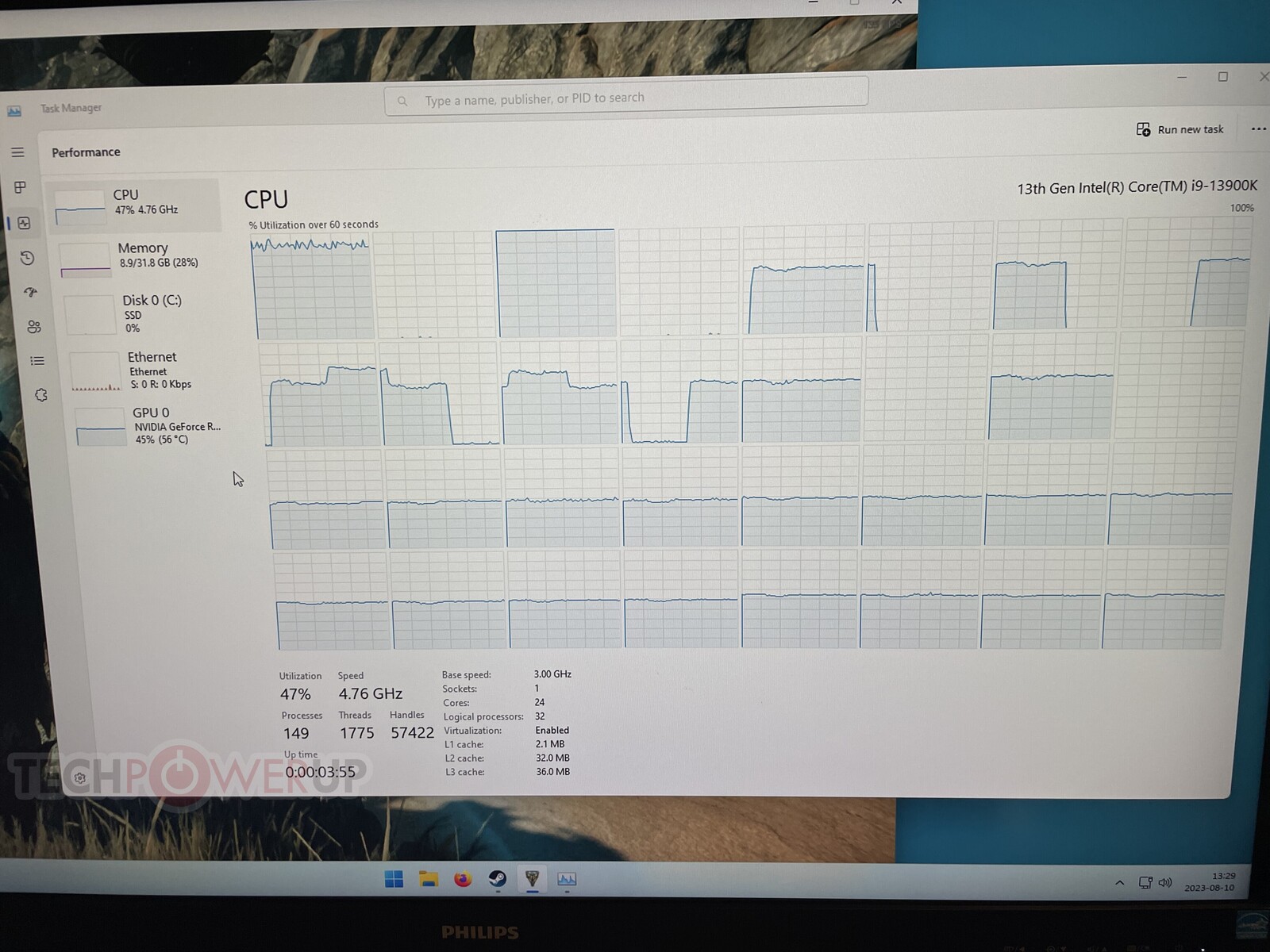
While the game does utilize all CPU cores, which is generally a positive aspect, it becomes problematic when it saturates not only the 8 P-cores but also the 16 E-cores. This results in a frame rate of under 80 FPS during intense gameplay at 1080p with a GeForce RTX 4090. Interestingly, disabling the E-cores restores performance.
Typically, when a game saturates all E-cores, it is interpreted as the game being unaware of their presence rather than being designed to utilize them. An ideal Hybrid-aware game would utilize the P-cores for its primary workload and assign tasks such as audio processing, network handling, physics, and asset decompression to the E-cores. These tasks would appear as intermittent and irregular loads in the Task Manager. However, "Atlas Fallen" seems to be using the E-cores for its main worker threads, resulting in a performance penalty when compared to disabling the E-cores. This penalty is due to the E-cores running at slower clock speeds, having lower IPC, and experiencing cache starvation. As a result, frame data processed by the P-cores must wait for data from the E-cores, leading to a decrease in overall framerate.
In the provided Task Manager screenshot, the game is running in the foreground, and we have set Task Manager to always be on top to prevent interference from Thread Director. However, the game does not allocate the P-cores to foreground tasks as expected, as the developers have specifically assigned work to the E-cores.
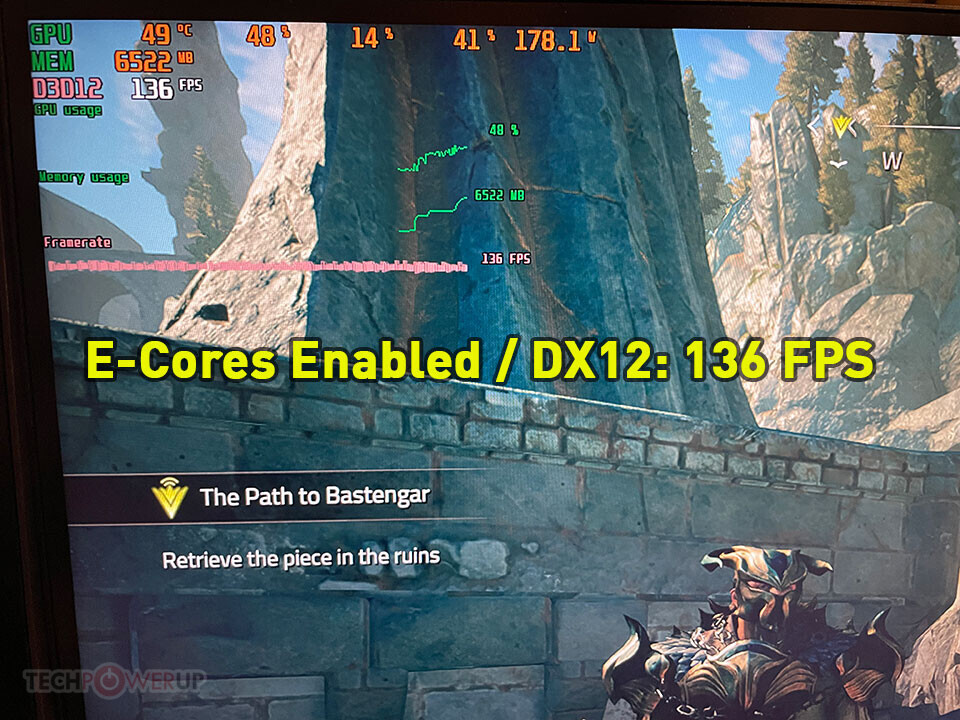
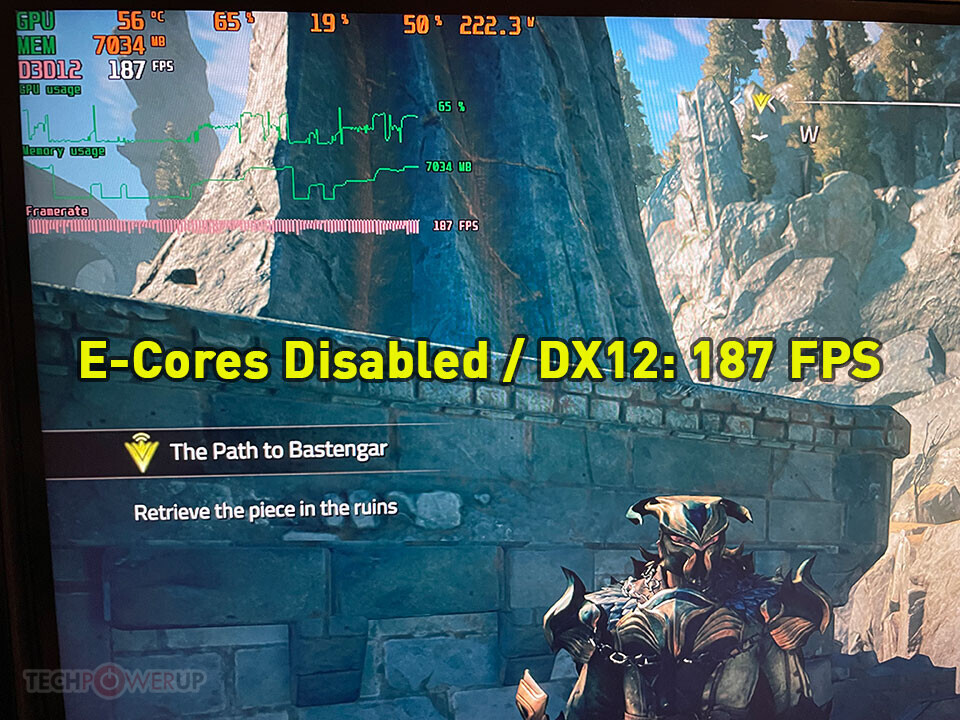
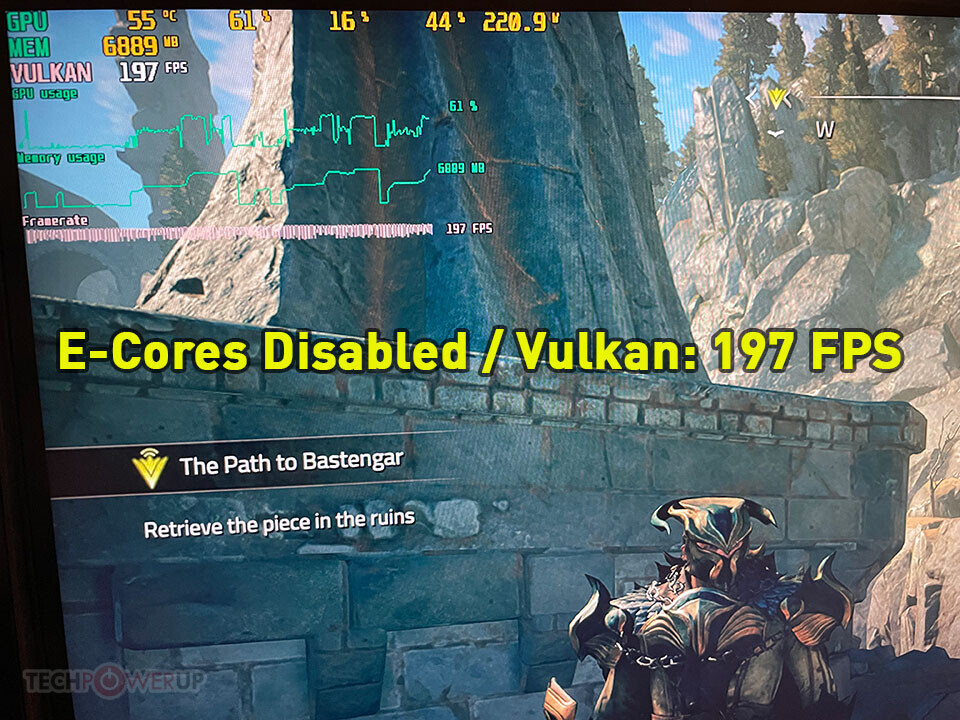
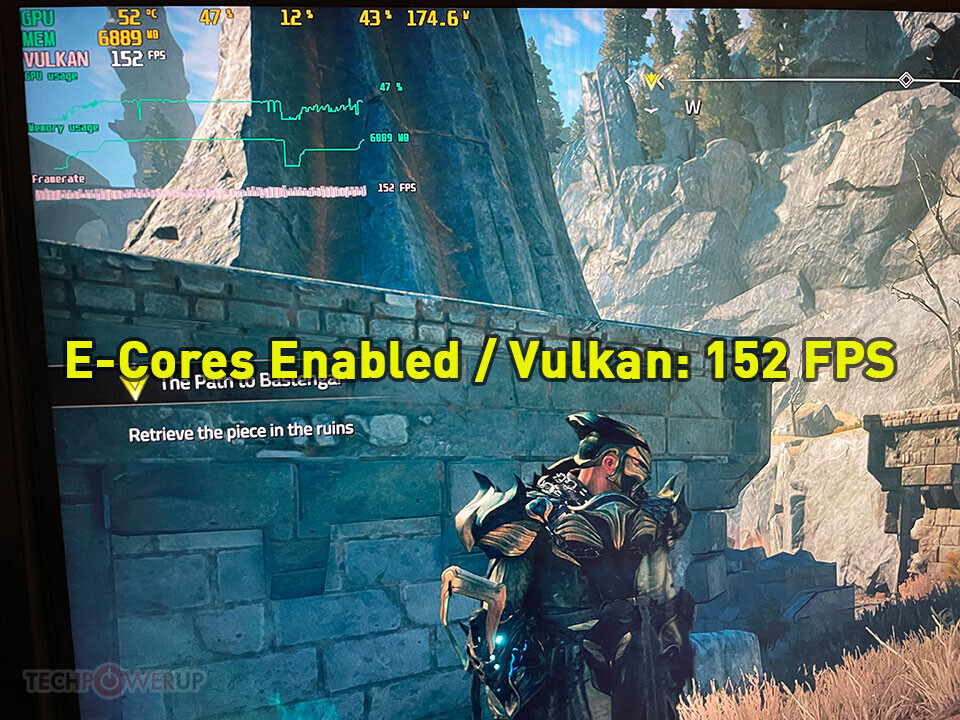
For comparison, we captured four screenshots with the E-cores enabled and disabled. We selected a typical average scene rather than a worst-case scenario, resulting in slightly higher FPS. As shown, enabling the E-cores yields lower FPS (136 / 152), while disabling them instantly increases performance up to the engine's internal FPS cap (187 / 197).
With the E-cores disabled, the game effectively runs on an 8-core/16-thread processor with only the P-cores, which can boost well above 5.00 GHz and have the full 36 MB L3 cache to themselves. Consequently, the framerate reaches 200 FPS, which is the developer's hard framerate limit. Considering the increasing availability of high refresh-rate monitors, such as 240 Hz or 360 Hz options, it would be beneficial for developers Deck13 Interactive to consider raising the limit. "Atlas Fallen" is based on the Fledge engine and supports both DirectX 12 and Vulkan APIs. Our testing was conducted using GeForce 536.99 WHQL drivers. Stay tuned for our comprehensive performance review of "Atlas Fallen" later today.